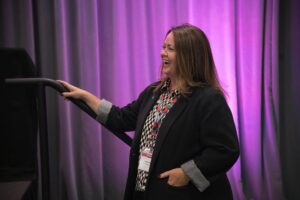
I had the pleasure of attending the Dollars and Sen$e Conference in Winnipeg, Manitoba, this year, and I had a wonderful time. Our opening plenary pulled out all the big guns, including CUPE National President Mark Hancock and CUPE National Secretary-Treasurer Candace Rennick. Both gave great speeches filled with powerful words, which was a fantastic way to get everyone fired up for the conference.
The RAND Formula and the Fight for Workers’ Rights
Our first panel was “The RAND Formula and the Fight for Workers’ Rights,” an informative discussion moderated by former National President Paul Moist. The panelists were Lily Chang, Secretary-Treasurer for the Canadian Labour Congress; Ella Henry, Legal and Legislative Representative for CUPE; and Magali Picard, President of the Québec Federation of Labour, who was also a hilarious person to have on the panel.
For those unfamiliar with the concept, the RAND Formula is the principle in federal labour law that allows union dues to be automatically deducted from the paycheques of workers covered by a collective agreement. Before the RAND Formula, unions had to collect dues individually from each member.
What is happening now is that Alberta and Quebec have both passed Bill 32. This legislation requires unions in those provinces to divide their expenses into two categories:
- Core dues: Expenses such as paying bills, collective bargaining, and other activities that directly benefit workers in the workplace.
- Non-core dues: Expenses related to issues such as fighting for CPP, health and safety regulations, and other social or charitable causes that could be considered optional.
Workers in these provinces now have the option to opt out of the portion of their union dues that covers non-core expenses, paying only enough to cover the core portion.
As a result, unions are struggling with reduced funding for education and awareness initiatives. This can make it more difficult for unions to educate members and the public about important issues and build public support for their work.
Fraud Identification and Prevention

Our second panel was a presentation by Mike Stevens on Fraud Identification and Prevention. Even though fraud is not a common occurrence in unions, there still need to be proper controls in place to prevent it from happening.
A lot of fraud can be caught by Trustees, so it is important that they are properly trained and take a thorough look at union records, bank statements, and copies of cheques to make sure everything is in order.
Workshop 1: Bylaw Essentials
Learn the principles of good bylaws and how to make sure they are in compliance with CUPE’s National Constitution. Look at how clear-language bylaws help our members get involved.
This was a very informative workshop that walked us through all the steps involved in having bylaws approved by CUPE National, as well as what constitutes a good bylaw.
There was discussion about the roles outlined in CUPE National’s Constitution and what responsibilities National and Local Officers have, as well as how these roles benefit our members.
The presenters also discussed what constitutes regular monthly wages and what is not included when calculating dues. If you are unsure how your employer is calculating dues, you need to have a discussion with your employer to make sure everything is being calculated correctly.
We also discussed whether Local Unions need to issue T4s or T4As for honorariums they pay. The presenters did not have an answer at the time, but at the end of the conference it was announced that they had consulted with a tax accountant who works with unions. We were advised that, yes, if a Local Union provides honorariums, it is legally expected to issue a T4 or T4A.
I will be getting in touch with an accountant in the near future to discuss what needs to be done and will report back following that meeting.
Workshop 2: Budgeting
Empower your Local Union with the important skills to create a strong budget that supports your goals and allows you to make timely, strategic decisions throughout the year.
This workshop dealt with four basic objectives:
- Why do an annual budget?
- Preparing an annual budget.
- How to read, understand, and analyze monthly and annual financial statements.
- Presenting budgets and financial reports with variances.
The first point was pretty basic, and we all know why we do an annual budget, so I won’t get into that too much. The second point, however, was fun to explore.
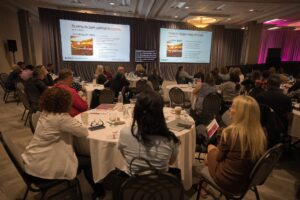
We discussed what to do with the budget if we receive a dues increase or if an employer were to announce layoffs. We learned how to budget for interest on investments and how to properly budget for cost-shares from National when we do not always know in advance exactly how much they will be.
We also looked at identifying expenses, including fixed versus variable expenses, and figuring out how to determine what those expenses will look like for the upcoming year.
Point three covered a lot of ground. We talked about balance sheets, income statements, cash flow statements, and notes to financial statements, including how to properly prepare each one.
Point four delved into how financial statements can be prepared, whether they are treasurer-prepared, a Notice to Reader, a Review Engagement, or an Audit, as well as the level of reliance each one provides to the end user.
Workshop 3: CUPE Per Capita Taxes and Electronic Ledger
Understand the payment structures to CUPE and the processes behind remittances of Local Union dues. Gain an understanding of how to use the online CUPE electronic ledger.
This workshop was broken into two parts. The first focused on per capita taxes, while the second focused on the electronic ledger.
Part one discussed the differences and benefits of regular remittance versus direct remittance, and how to decide which option is the best choice for your Local. The presenters also discussed the differences between regular and gross wages and how union dues are structured.
Part two was a step-by-step tutorial of the electronic ledger, starting with where to find and download it and progressing all the way through to finishing the year. They went into detail on everything in between.
Many examples were given on how to properly input stale-dated cheques, investments, transfers between accounts, and other transactions. We were also given some Excel tips for using the ledger and making our bookkeeping more effective.
Overall
Overall, this was a fantastic conference. I learned a lot and got to meet many people who were just as excited about being a Treasurer as I am. If they weren’t excited about being Treasurers before they arrived, they sure were by the time they left!
I am already looking forward to the next Dollars and Sen$e Conference. There is still so much more to learn, and I would love to have the opportunity to attend some of the other workshop options that I wasn’t able to experience this time.
Darrelle Downs – Secretary Treasurer, CUPE 2268